First Buck podcast (2025): Brian Scudamore’s journey from hauling junk to a $700 million empire




TL;DR
Joining host Nicolas Cary on The First Buck podcast, 1-800-GOT-JUNK? founder and CEO Brian Scudamore reflects on earning his very first dollar in the junk removal industry. From spotting a hauling truck in a McDonald's drive-thru in 1989 to building a $700 million junk removal empire, Brian breaks down essential lessons for aspiring entrepreneurs.
- He shares how reading The E-Myth Revisited inspired him to build scalable systems, building out a franchise model long before 1-800-GOT-JUNK? first franchised in Toronto.
- "It's all about people" philosophy: Brian shares how firing his whole team after five years in business led him to focus on hiring around attitude, and training for skill.
- Adopting a WTF - Willing to Fail" attitude is essential for entrepreneurs to turn setbacks into breakthrough success.
Published by: Sky's The Limit
Host: Nicolas Cary
Guest: Brian Scudamore, Founder and CEO of 1-800-GOT-JUNK?
Originally aired May 8, 2025.
Brian Scudamore joins Nic Cary on The First Buck podcast
“At just 19 years old, he pioneered the industry of professional junk removal with 1-800-GOT-JUNK?, turning a chore everyone avoids into an exceptional customer service experience.”
That was high praise to receive from Nicolas Cary right before joining him on The First Buck, a podcast dedicated to sharing stories about entrepreneurs. It wasn’t long before we were jumping right into the questions and detailing my journey founding 1-800-GOT-JUNK?.
Earning my first buck from a $700 pickup truck
Nic first kicked things off with his traditional opening question: "How did you earn your first buck?"
My journey started as a high school dropout. I was one course short of graduating and struggled in school, attending 14 different schools from high school through college because I couldn't sit still in a classroom. In 1989, at 18 years old, I decided to enter college anyway and needed a way to pay my tuition. The eureka moment hit me in a McDonald's drive-thru in Vancouver, Canada, where I saw a beat-up truck with plywood sideboards painted with "Mark's Hauling." I realized hauling unwanted items to the dump was a simple, essential service everyone needed.
I bought a pickup truck for $700, painted my phone number on the side, and launched The Rubbish Boys. My very first job came from a newspaper classified ad, earning $120 to haul away a customer's junk. Within two weeks, the business paid for the truck. Realizing I learned far more about real-world business on the street than in lecture halls, I dropped out of university with one year left to go all-in, turning that $700 truck into a $700 million global brand.
Why systems and the E-Myth mindset make scaling possible
When I dropped out of school, my first move to prove to my father that I was serious was buying a second truck. Doubling my fleet doubled my revenue and gave me confidence. By 1995, I grew the fleet to five trucks but hit an operational wall: I could only physically drive one truck at a time. To expand, I needed every truck to deliver the exact same exceptional customer experience.
That breakthrough came when I read Michael Gerber's book, The E-Myth Revisited, which teaches that people don't fail; systems do. To scale, you must build simple, repeatable systems so operations run smoothly regardless of who is driving. We defined clear brand promises at 1-800-GOT-JUNK? to set us apart:
- On-time service
- Upfront, transparent prices
- Clean, shiny trucks
- Friendly, uniformed drivers
By organizing our booking, dispatching, and customer service into simple operating manuals, our company acted like a franchise long before we franchised. We weren't just selling junk removal; we were selling peace of mind, ease, and emotional relief.
Unlocking nationwide growth through franchising and mentorship
Ten years into running the business, I realized franchising was the ultimate way to scale our proven recipe. Rather than raising venture capital or taking on heavy bank debt, franchising allowed me to partner with passionate entrepreneurs who wanted to "BYOB"—build their own business and be their own boss.
Our first Franchise Partner was Paul Guy, a former VP with College Pro Painters. In 1999, Paul drove a junk truck thousands of miles across Canada from Vancouver to Toronto to launch our first franchise location. What took me eight years to build to $1 million in revenue in Vancouver, Paul accomplished in his very first year in Toronto, proving our franchise model was unstoppable.
My advice to early-stage entrepreneurs on The First Buck podcast is to wait as long as you can before raising money. Bootstrapping forces you to master operations, protect cash flow, and build a profitable model first. To guide my growth, I created a Mentor Board of Advisors (MBA) of world-class leaders (including marketing expert Seth Godin), reaching out whenever I needed to solve complex challenges.
Why hiring for attitude builds great teams
Wearing my "It's all about people" hat on the podcast reminded me of one of the hardest days of my career. Five years in, with five trucks and 11 employees, I was no longer having fun because nine team members were "bad apples" who weren't happy, smiley people.
I called a morning meeting, apologized for letting them down as a leader, and fired all 11 employees at once. Going from five trucks down to the single truck I could drive myself was hard, but that reset taught me that 1-800-GOT-JUNK? is fundamentally a people business.
From that day on, I vowed to hire only friendly and happy people using the "beer and barbecue test":
- The Beer Test: Would I enjoy sitting down to have a casual beer or coffee with this person?
- The Barbecue Test: Would this candidate fit in and add positive energy at a company-wide barbecue?
We hire for attitude and train for skill. Today, our friendly two-person teams represent our brand with pride across North America and Australia.
Developing a WTF attitude
The core theme of my book, WTF? Willing to Fail: How Failure Can Be Key to Success, is that fear of failure holds back brilliant ideas. In business, mistakes aren't fatal—they are the stones that pave the road to greatness.
Managing stress as an entrepreneur comes down to changing your relationship with rejection and being willing to collect "no’s" until you get a "yes":
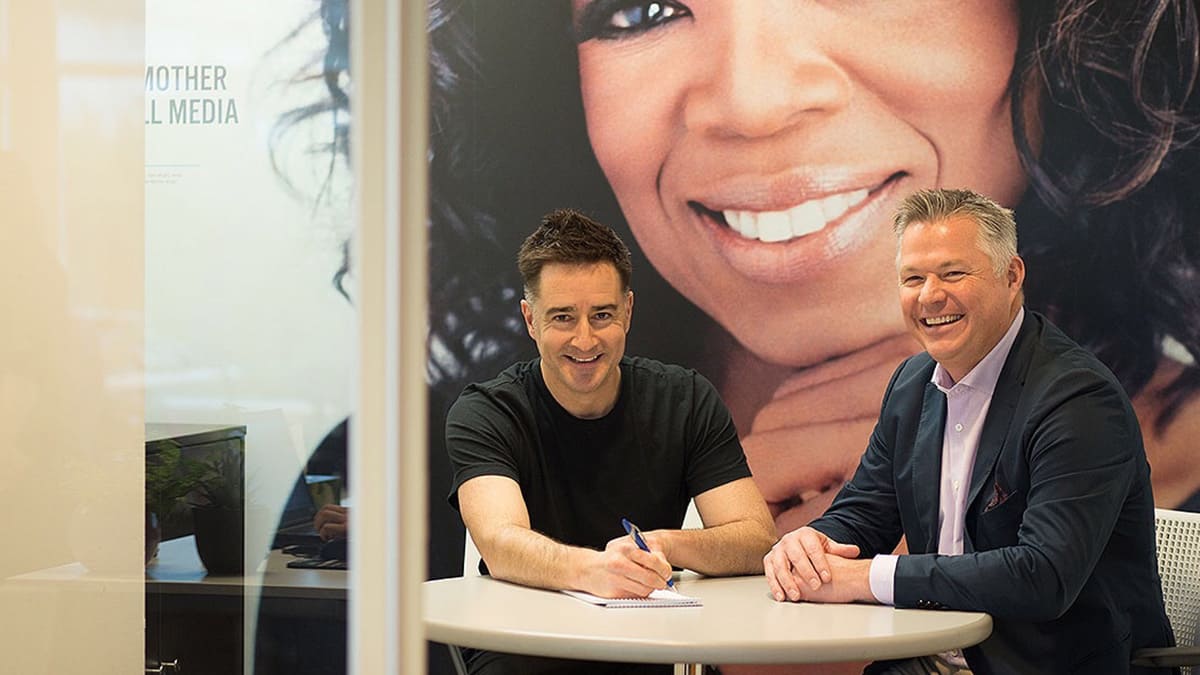
- It took 14 months of pitching Harpo Studios before landing on The Oprah Winfrey Show.
- It took five attempts before appearing on The Ellen DeGeneres Show.
- It took three tries before sitting down with Guy Raz on NPR's How I Built This.
Be willing to fail, take calculated risks, and trust that every obstacle is simply preparing you for breakthrough success.
Read the full interview
It was great to speak with Nic Cary all about my entrepreneurial journey founding 1-800-GOT-JUNK?, and providing a few bits of business wisdom that I’ve learned over the last 36 years. I’m always happy to share advice with other entrepreneurs, just like I was mentored and supported along the way too.
Interested in reading the full conversation? Expand below to hear even more of my story on The First Buck podcast.
Announcer: [00:00:04:22 - 00:00:23:25] Welcome to The First Buck podcast, where we feature stories about entrepreneurs and the people who support them. Now, let's get started with the show.
Nicolas Cary: [00:00:23:27 - 00:00:48:02] Hello and welcome to The First Buck podcast, brought to you by Sky's the Limit. We feature stories about entrepreneurs and the people who support them. Today, we're joined by serial entrepreneur and author Brian Scudamore, who has always taken the road less traveled. At just 19 years old, he pioneered the industry of professional junk removal with 1-800-GOT-JUNK?, turning a chore everyone avoids into an exceptional customer service experience.
Nicolas Cary: [00:00:48:03 - 00:01:06:16] I have some friends who work for 1-800-GOT-JUNK?. Brian has scaled that business into two more home service brands: WOW 1 DAY PAINTING and Shack Shine, all under the O2E Brands banner. Brian has learned the ins and outs of business by running his own, and believes that anyone with a fire in their gut and a vision to do something incredible can do the same.
Nicolas Cary: [00:01:06:21 - 00:01:26:29] His philosophy, "WTF - Willing to Fail," stems from his belief in the power of dreaming big, taking risks, and learning from mistakes. Through franchising, he's giving thousands of aspiring entrepreneurs a chance to “BYOB”: build their own business and be their own boss, living the dream of business ownership. If you want to follow up on this, we have some books for you to read.
Nicolas Cary: [00:01:26:29 - 00:01:40:18] You can read WTF? Willing to Fail: How Failure Can Be Key to Success and Build Your Own Business, Be Your Own Boss at BrianScudamore.com. Without further ado, we have a little tradition around here. We need to find out: How did you earn your first buck?
Brian Scudamore: [00:01:40:21 - 00:02:05:02] My first buck: I was a high school dropout. I was actually one course short of graduation. Very ADHD by nature, I couldn't sit still in school. I went to 14 schools, actually, from high school to college. I was kicked out, couldn't focus. So, I started a business as someone who didn't finish high school. I started a business to pay for college, and I was in a McDonald's drive-through of all places.
Brian Scudamore: [00:02:05:02 - 00:02:22:20] I saw this beat-up old pickup truck in front of me. It had plywood sides on the box and it said 'Mark's Hauling' on the side. I looked at that truck and thought, 'I want to do what Mark's doing. I'm going to buy a truck, haul junk when people have stuff that needs to go off to the dump, and that would pay for college.'
Brian Scudamore: [00:02:22:23 - 00:02:45:16] Well, sure enough, I bought my truck and started a company. At the time, I called it The Rubbish Boys. It was really just me, but I had a vision for something bigger. I got out there, and from day one I was making money. That first buck came from a customer where I showed up. I had put a little ad in a classified newspaper, and they called me up. I thought, 'Oh my gosh, this works!'
Brian Scudamore: [00:02:45:18 - 00:03:09:00] I showed up and hauled away the junk. It was $120. The business proved itself: okay, there's some cash to be made from trash. Ultimately, what funded my way through college inspired me to drop out of college with a year left in my degree. I was learning much more about business, running a business, than I was studying business in school.
Brian Scudamore: [00:03:09:03 - 00:03:27:00] So, I sat down with my father, who is a liver transplant surgeon, and said, 'Dad, I'm quitting school.' He thought, 'Oh my gosh, my son's crazy!' He looks back today and says, 'Brian, you made the right decision.' We built a $700 million business off of what started with that first truck and a buck.
Nicolas Cary: [00:03:27:07 - 00:03:52:20] I love that: cash out of trash. Wow, what an awesome story. Thank you for sharing that with us. You found your first customer basically by putting an ad up in the classifieds. Tell us a little about how you went from one truck to two trucks to more. Tell us a little bit about that early scaling and how you got comfortable taking increasing amounts of financial and personal risk with the business.
Brian Scudamore: [00:03:52:22 - 00:04:16:00] To paint the picture: we are at about 2,500 trucks with 1-800-GOT-JUNK? and hundreds and hundreds more vehicles with WOW 1 DAY PAINTING and Shack Shine. What started from a first truck, for many years while I was funding my college education, I went to a second truck when I had the courage to drop out of school and go all in.
Brian Scudamore: [00:04:16:03 - 00:04:38:27] I went all in on my business. The first logical move was to prove to my father I was making a good decision and I was serious, I bought a second truck. I doubled my fleet, doubled my revenue, and started to gain the confidence that, wow, this could scale. I read a book called The E-Myth Revisited in 1995, about five years into my business.
Brian Scudamore: [00:04:39:00 - 00:05:03:17] The E-Myth Revisited speaks to the entrepreneurial myth. It's a book that tells you to build systems in your business if you really want to scale. People don't fail: systems do. Establish the systems that will allow you to grow and scale, because I can only drive one truck at a time, right? But when I expand to three, four, or five trucks, how will I have the people and the processes to make it successful?
Brian Scudamore: [00:05:03:19 - 00:05:29:19] That book, The E-Myth Revisited, inspired me to start putting systems in place and adding more trucks. In five years, I was up to five trucks. I realized there was an opportunity to take what I do very well: customer experience, hauling away junk, and making someone feel so thrilled that they've got the relief of their junk being gone and they've got their space back.
Brian Scudamore: [00:05:29:22 - 00:05:50:01] I could set that up in such a way where it could look and feel like a franchise. I could have someone run Vancouver Island and Victoria: I could have someone run Seattle. As we expanded, my business eventually looked, felt, and acted so much like a franchise that that was the model I chose to grow with.
Brian Scudamore: [00:05:50:03 - 00:06:11:12] Ten years into the business, I had our first franchise running, which was a fellow in Toronto who ran our Vancouver operation. He had a girlfriend in Toronto, and he decided to drive a truck thousands of miles across the country to start the first franchise. What took me eight years to get to a million in revenue,
Brian Scudamore: [00:06:11:14 - 00:06:24:19] Paul Guy, our first franchise partner, did in a year. That's when I knew I was on to something. I had a business, a franchise model, and off we scaled to build a $700 million brand today.
Nicolas Cary: [00:06:24:21 - 00:06:30:17] That is very cool. So, how did you find Paul? What's the story with that?
Brian Scudamore: [00:06:30:20 - 00:06:54:22] There was a company called College Pro Painters, where students would come in and paint your home. They had real business savvy behind how they were teaching young entrepreneurs to run a business to pay for college. Paul was a VP with College Pro. When I looked to scale my business, I went and found him.
Brian Scudamore: [00:06:55:00 - 00:07:12:05] I found him through my networks, and he was the perfect guy to come in and help me put some really good systems in place in my business. What was interesting was the opportunity that he and I saw was much bigger. I said to him, 'Have you ever thought of being your own boss?' He said, 'Well, not really.'
Brian Scudamore: [00:07:12:07 - 00:07:32:28] I said, 'Well, you have a girlfriend in Toronto. You are spending a lot of time back and forth. What about starting Toronto?' His eyes lit up. We both did. It was like that magical moment where the angels are singing. You feel like a better dancer and you think, 'Wow!' That was the moment, and off he went.
Nicolas Cary: [00:07:33:01 - 00:07:50:01] That's cool. I was curious, a lot of our entrepreneurs at Sky's the Limit struggle with making decisions about what business model to pursue. It would be interesting to hear what you think: when is a franchise model the right model?
Brian Scudamore: [00:07:50:04 - 00:08:10:15] There are two things there. First, what is the right business? I often think it's the one that's right in front of you. I look at 1-800-GOT-JUNK? and I see a pickup truck in a McDonald's drive-through. I saw that there was a need, and I thought, 'That's my opportunity. Buy a truck for $700 and start hauling away junk.'
Brian Scudamore: [00:08:10:17 - 00:08:32:16] I am a dragon on a show called Dragon's Den, and one of the investments we did this year was these two women who have a company called Mint. They offer environmental cleaning products. Their service was right in front of them. They were out cleaning Airbnbs for a living, and they were using harmful products that made one of them sick.
Brian Scudamore: [00:08:32:19 - 00:08:55:01] Instead of just looking at the negativity in life, they said, 'These products shouldn't make you sick. What would it take to have something healthier?' They created a $5 million business in cleaning that is just taking off. I think it's about looking right in front of you: what's in front of your face every single day that you could do better than anyone else?
Brian Scudamore: [00:08:55:04 - 00:09:24:17] How do you choose a model like franchising? Franchising, to me, is a way of raising money. Some people go public, some people raise seed capital, some people borrow from the bank of Mom and Dad. For me, raising money through franchising meant I could give my recipe of proven success to someone, having them run a business under my recipe, under our brand 1-800-GOT-JUNK?.
Brian Scudamore: [00:09:24:19 - 00:09:52:09] We could teach them: we could support them. They don't need the idea: they just need to be able to execute. Franchising is an expensive model to put into place. You do need, I think, 50 to 100 franchise partners before you start making money in franchising, because you're taking a little piece from everybody. But it's a great way to raise capital, to then scale a model quickly if you find the right people.
Nicolas Cary: [00:09:52:11 - 00:10:16:06] Very cool. Thank you for sharing that. A lot of entrepreneurs, I think, struggle with this concept of raising money. They all think that if they just had a lot of money, their problems would be sorted and fixed. It would be interesting to hear what you think: what advice do you give to early-stage businesses, and where should they be focusing and spending their time when they're always stressing about maybe raising money?
Nicolas Cary: [00:10:16:06 - 00:10:19:18] Is that really the first place that they should spend their time?
Brian Scudamore: [00:10:19:20 - 00:10:41:29] My strong belief, though not everyone would agree, is to wait as long as you possibly can to raise money. Wait as long as you can before you start spending a ton of money. In my case, with 1-800-GOT-JUNK?, it was ten years before we franchised. I figured out every system and process so that Paul Guy in Toronto could run it as well.
Brian Scudamore: [00:10:42:01 - 00:11:05:19] Or, clearly, better than I could ever run it because the processes were so tight. I've seen so many potential franchise partners fail, saying, 'We've been in business for two years. Everything's great now, but our operations aren't profitable, and we're going to scale this.' It doesn't work. You need the time and energy to make sure everything is in place to scale successfully.
Brian Scudamore: [00:11:05:19 - 00:11:27:03] If your franchise partners fail, the whole thing implodes. I've seen people on the money-raising side, with seed capital. They go out and raise money: they then have that million-dollar check, and they don't spend money as carefully or as wisely as they did when they bootstrapped. All this money comes in, and suddenly there are big parties, this and that.
Brian Scudamore: [00:11:27:06 - 00:11:48:17] It kills a lot of companies. I see you nodding: you understand it. We've all seen our friends and entrepreneurs who've gone bankrupt, who have made a business fail because they've spent too much money too quickly. So, back to my advice: wait as long as you can before raising money until you have such a proven model that can scale.
Brian Scudamore: [00:11:48:19 - 00:11:54:20] It's not a race. It's about getting it right long-term so that you can sustainably grow.
Nicolas Cary: [00:11:54:23 - 00:12:18:05] One of the things I was reading about in your background, and I know it's something you're passionate about, is building cultures and building teams. No one achieves anything on their own. Building your team is foundational and critical to putting the components in place to help yourself and then help the whole organization.
Nicolas Cary: [00:12:18:06 - 00:12:36:11] I wanted to ask you a little bit about that, and maybe talk us through some lessons you have about hiring and how to do it well, and what you're still learning about that. Any business owner will say they've made some amazing hires over their careers and they've made some disastrous ones.
Nicolas Cary: [00:12:36:11 - 00:12:44:10] It's not always obvious what works and what doesn't, but it would be interesting if there are any pearls of wisdom you've gathered over the years.
Brian Scudamore: [00:12:44:12 - 00:13:03:03] By absolute fluke, I'm wearing my "It's all about people" hat today. I like to wear different hats with different slogans of ours on a podcast. The "It's all about people" philosophy was learned five years into my business. I had a team of 11 people, a company of 11, and I realized I was not having fun anymore.
Brian Scudamore: [00:13:03:05 - 00:13:25:10] It was scaling, but not the way I had imagined. They say one bad apple spoils the whole bunch. Nine out of 11, I think, were bad apples. They just weren't a fit for me. They didn't have the attitude that this is a business and we're taking care of customers. They weren't happy, smiley, friendly people, and I realized I needed to make a change.
Brian Scudamore: [00:13:25:12 - 00:13:43:26] So, I brought all 11 people in for a morning meeting, even though I might have kept two. I was worried that maybe the culture was beyond repair. I sat down and started with two powerful words. I said, 'I'm sorry. I'm sorry that I've let you down as a leader. I might not have found the right people nor treated you right.'
Brian Scudamore: [00:13:44:01 - 00:14:09:26] 'I'm not having fun in my business. It's not working, and I need to start again.' So, I went from 11 down to zero, from five trucks down to just the one I could drive. I said, 'Time to rebuild,' and began rebuilding with the premise of "It's all about people": find the right people and treat them right. The easiest thing in my entire business growth over the years is team building.
Brian Scudamore: [00:14:09:28 - 00:14:32:24] When we have the right people in place, it just happens like magic. It's like a good house party where everyone thinks, 'This is the place to be!' We focus on finding the right people, and the way we do that, we call it the 'beer and barbecue test.' When I sit down and interview someone, I ask myself, 'Would I have a beer with this person after the interview?'
Brian Scudamore: [00:14:32:26 - 00:14:54:08] 'Do I find them interesting and interested? Do they have a shared common passion? Are they just the right fit for this place?' Then we go through what I call the 'barbecue test.' I visually think through what they would be like at a company barbecue. Would they fit in? Would they add to it? We are not looking for everybody to be the same.
Brian Scudamore: [00:14:54:08 - 00:15:15:13] We're looking for diversity of opinions, backgrounds, and skills, and so on. But do they fit? Do they belong at that company barbecue? We use it in our interviewing. It's one thing for someone to sit down and tell me about a time they did this, this, and that, and how it went. But it's another thing to just ask, 'What do you like to do for fun?'
Brian Scudamore: [00:15:15:15 - 00:15:34:29] 'What makes you tick? What are you fired up about in this world?' Getting to know someone as if you're having a beer together, I think, gives you a completely different perspective. We hire for attitude: we train for skill. Team building is easy when we have the right people in place.
Nicolas Cary: [00:15:35:01 - 00:15:59:07] Hire for attitude and train on skill. I love that. You talk a lot about how important mentorship is, and I was interested to hear who your mentors were, and to talk a little bit about the dynamic you've had with people who have shared experiences with you, and how you get the most out of those types of knowledge transmissions.
Brian Scudamore: [00:15:59:09 - 00:16:25:13] To me, it's interesting: I developed a philosophy. I created what I call a Mentor Board of Advisors, an MBA. I couldn't get my own MBA in life. Clearly, I couldn't finish high school or college. Why try again? I created this Mentor Board of Advisors, which to me meant: when I'm trying to solve a problem, when I'm looking for answers, who is the best on the planet to go to?
Brian Scudamore: [00:16:25:15 - 00:16:40:24] I could read a book. I find an article about someone who imparts some wisdom, and then I reach out and have a further conversation. I've done it with Seth Godin, who I think is one of the world's most brilliant marketers.
Nicolas Cary: [00:16:40:25 - 00:16:48:29] Yes, he's been on the podcast, and he was so good at teaching me about product-market fit and thinking about communication. He's amazing.
Brian Scudamore: [00:16:49:01 - 00:17:08:16] He's phenomenal. I picked up the phone one day and reached out, and he took my call. I met him in his office in New York, and we just connected and kept in touch. To me, it's not one person as a mentor forever with a formalized relationship: it's about finding someone I need to reach out to and connect with if I'm trying to solve a problem.
Brian Scudamore: [00:17:08:16 - 00:17:33:26] I have hundreds of people. I have people in life who help me with anxiety, business growth, family challenges, you name it. Whatever the thing I'm trying to solve and get better at, I can reach out to someone who can help support. It's amazing. People reach out to me all the time, and if I can help, I'm there.
Brian Scudamore: [00:17:34:02 - 00:17:49:11] It's usually just a phone call or a Zoom, and we talk about something they need to unlock. I think entrepreneurs are really good at helping other entrepreneurs because they remember the early days of what it was like when they were getting going.
Nicolas Cary: [00:17:49:13 - 00:18:11:01] One hundred percent. I'll finish with one last question for you. You've been really open about some of the challenges entrepreneurs face, whether it's anxieties or stress. Pursuing entrepreneurship can feel scary. What tips would you give aspiring entrepreneurs listening?
Nicolas Cary: [00:18:11:04 - 00:18:17:04] What are some things they can think about to help manage the stress that comes with running and building your own business?
Brian Scudamore: [00:18:17:06 - 00:18:40:20] You mentioned my book earlier, thank you. My first book, WTF? Willing to Fail, addresses this. I think the one thing I figured out that wipes away any anxiety in business is this: when things get hard, when something doesn't go as planned, you think, 'Wow, I just made a mistake,' or 'I really screwed up here.'
Brian Scudamore: [00:18:40:22 - 00:19:05:05] What did I learn? What is the one great thing that can happen from this seemingly hard time? I often write it down, and sometimes there's a big list. Every challenge I've ever had in business was an important challenge to have. I wouldn't take it away. I needed to learn that lesson to get to where we are today.
Brian Scudamore: [00:19:05:08 - 00:19:29:06] We couldn't build a $700 million business if it wasn't for all the mistakes that paved that way. Tying it back, what is the one word of advice? Be willing to fail. Be willing to take a risk. Don't make stupid risks, but take calculated risks or whatever you're comfortable with. When it doesn't go right, when you get a 'no,' collect that 'no.'
Brian Scudamore: [00:19:29:08 - 00:19:49:03] Collect a whole bunch of 'nos' until you get a 'yes.' When we got on The Oprah Winfrey Show, I don't know how many dozens and dozens of calls and emails it took. 'No, no, no, no, no' before we got a 'yes.' It took five to get on The Ellen DeGeneres Show. It took three to get on Guy Raz's “How I Built This” podcast.
Brian Scudamore: [00:19:49:09 - 00:20:04:00] People give up too soon versus having the ability to go, 'I might fail right now, but it's that failure, that learning, that rejection that will get me to greatness.'
Nicolas Cary: [00:20:04:02 - 00:20:37:06] I think that's an excellent lesson. I love the visual of how mistakes pave the way. In business, you're going to have lots of setbacks: you're going to have lots of obstacles. Each one of those is a learning opportunity. As you mentioned, looking back on those and writing down the list of what did I learn from this? If you build up that knowledge over time, stick with it and have the mindset that these are all learning opportunities. That's something in common
Nicolas Cary: [00:20:37:06 - 00:21:15:21] I've found with almost every entrepreneur we've interviewed who has reflected back on what their journey was like and what made it possible for them to survive it. Thank you so much. I love the whole story from the very beginning: having an ADD mindset in high school, starting up something from scratch, figuring out that you needed to put a team in place, and sometimes rebooting your whole team or reinstalling the operating system is necessary for scaling, to learning about franchising, and to relentlessly knocking on doors to get those opportunities to tell your story.
Nicolas Cary: [00:21:15:24 - 00:21:26:21] This has been an absolutely excellent overview. Brian, I really appreciate your time today. We'll put those books into the links on the podcast, and I really appreciate it.
Brian Scudamore: [00:21:26:21 - 00:21:34:13] Thank you. Well, thank you for having me. It's an honor to be able to meet you and to speak with your group of amazing entrepreneurs. Thanks, Nick.
Nicolas Cary: [00:21:34:14 - 00:21:51:28] Thank you. All right, Sky's the Limit.org. We connect underestimated entrepreneurs with volunteer business professionals for free, one-on-one mentoring. We also provide business guides to all our members and monthly funding opportunities. If you liked what you heard, please subscribe and share the podcast.
Announcer: [00:21:52:01 - 00:22:05:23] Thanks for listening to The First Buck podcast. Don't forget to join the community of underrepresented entrepreneurs and their supporters by signing up at Sky's the Limit. Click subscribe, and we'll see you next time.
Frequently asked questions
How was 1-800-GOT-JUNK? originally founded?
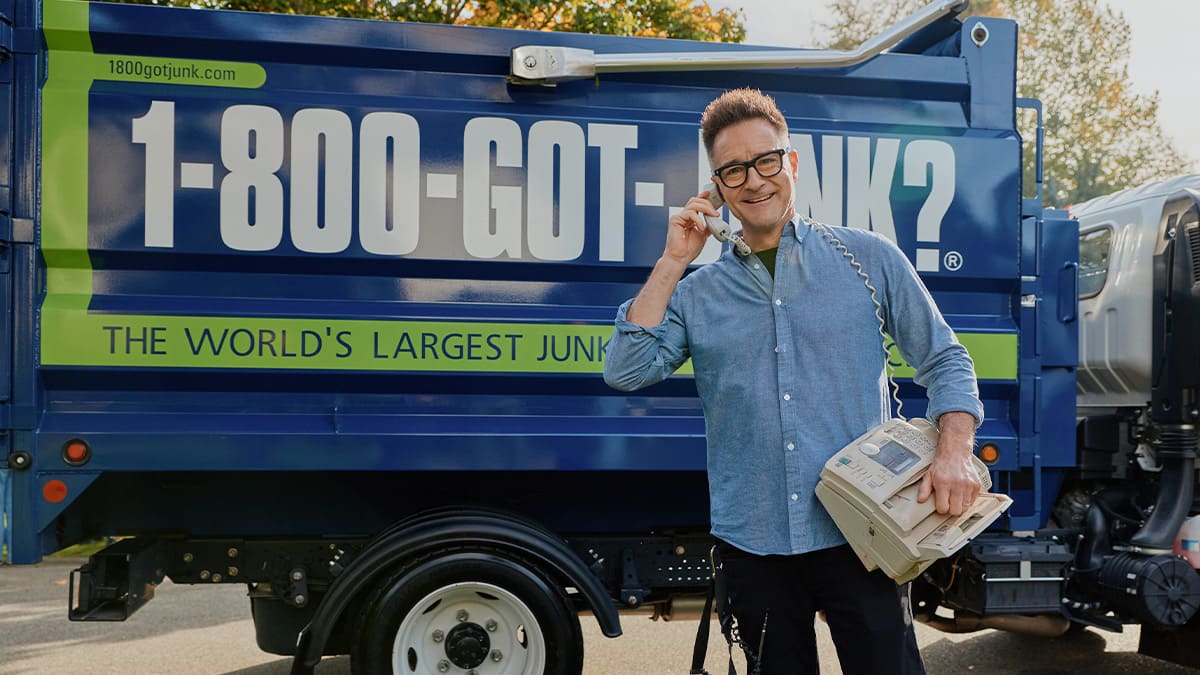
In 1989, 18-year-old Brian Scudamore bought a beat-up pickup truck for $700 after seeing a hauling truck in a McDonald's drive-thru. He initially named the business The Rubbish Boys to pay his way through college before committing to it full-time and growing the company into 1-800-GOT-JUNK?
How does 1-800-GOT-JUNK? deliver exceptional customer service?
1-800-GOT-JUNK? provides trusted relief by sending friendly, uniformed two-person teams in clean, shiny trucks. Our teams handle all the heavy lifting, offer upfront all-inclusive rates, and sweep up afterward to leave your space clean and spacious.
Why did Brian Scudamore fire his whole team early in the company's history?
Five years into running the business with five trucks and $500,000 in revenue, Brian Scudamore realized nine of his eleven team members lacked positivity and professionalism. He called a morning meeting, apologized for his leadership failure, fired all eleven employees at once, and reset the company back to a single truck. This hard reset taught him that 1-800-GOT-JUNK?. is fundamentally a people business, establishing his permanent rule to only hire clean-cut, friendly, and happy people.
How did 1-800-GOT-JUNK? get featured on The Oprah Winfrey Show?
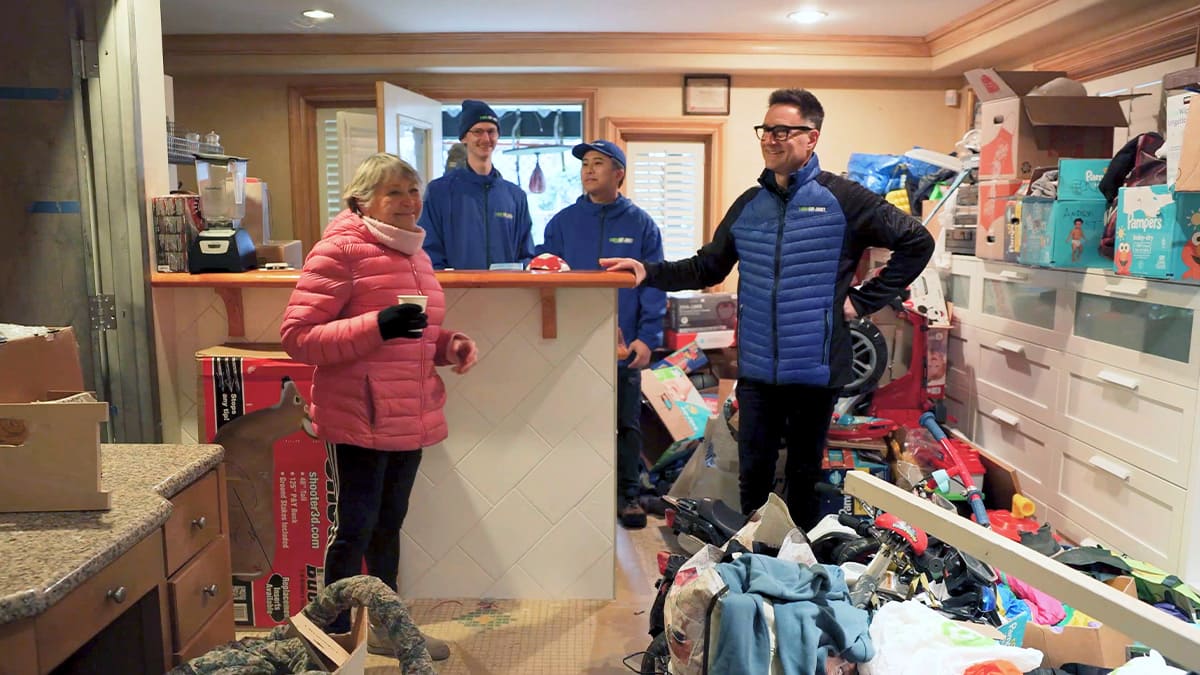
After 14 months of persistent outreach from PR hire Tyler — who wore a blue wig while pitching for motivation — Harpo Studios called needing a hoarder cleanout. The team flew in San Francisco franchise partners to help, since Los Angeles had no local franchise at the time.