How to remove a fence safely




If you're looking to revamp your outdoor space or replace that weathered, old fence with a fresh one, it's essential to know how to properly tear down and dispose of the old structure. Not only can this process be physically demanding, but it also requires careful consideration of how to handle the used materials in an eco-friendly manner.
Let’s walk through the steps to tear down an old fence and discuss environmentally responsible disposal options for the materials.
Step 1: Gather your tools and safety gear
Before embarking on the task of tearing down your old fence, it's crucial to have the right tools and safety equipment at your disposal.
Here's a detailed list of what you'll need:
- Safety gear: You’ll need goggles to protect your eyes from debris and hazards, gloves to guard against splinters and sharp edges, and work boots to give you good traction and prevent injuries from falling objects.
- Demolition tools: A crowbar or pry bar can help separate boards or panels from support posts. You’ll also need a hammer, screwdriver, and pliers. Depending on the size or difficulty of removal, you may need a circular saw or reciprocating saw to cut through tough support posts.
- Cleanup and disposal equipment: Use a tarpaulin or drop cloth to collect and bundle the removed fence materials and debris. Have plenty of heavy-duty trash bags ready for collecting smaller debris, such as nails, screws, and other waste. Consider a wheelbarrow to transport heavy or bulky materials.
Step 2: Inspect the fence
Before you begin the dismantling process, it's essential to thoroughly inspect your old fence. This step helps you assess the condition of the fence and identify any potential challenges you may encounter during removal.
Carefully examine the entire length of the fence to identify weak or damaged sections. Look for rot, warping, termite damage, or any signs of decay. Mark these areas for special attention during removal.
Take note of the type of fasteners used, such as nails or screws. Screws usually require less effort than nails.
If your fence is covered in ivy, vines, or other vegetation, trim or remove it before starting. This will make the dismantling process more accessible and less messy.
Be mindful of any nearby structures, such as buildings or neighboring fences, that might be affected during the removal process. Plan your approach to minimize potential damage.
Step 3: Remove any attachments
Once you've assessed the condition of your fence, it's time to remove any attachments or accessories that are connected to it. This step ensures that you're working with just the core fence structure during the dismantling process.
Begin by removing any gate doors. Use a screwdriver or a drill to take out the screws or bolts that secure the gate in place. Make sure to keep these hardware components if they are still in good condition, as they can be reused on your new fence or donated to others.
If there are decorative elements, such as planters, signs, or trellises attached to the fence, carefully detach them using the appropriate tools. Be gentle to avoid damaging these items if you plan to reuse or repurpose them.
Inspect the fence for any additional hardware, such as hinges, latches, or locks. Remove these components and set them aside for reuse or donation if they're still functional.
Step 4: Begin dismantling
Now that you've prepared the fence by removing attachments, you can start the dismantling process. Here's a detailed breakdown of how to do it safely:
- Start at one end: Choose one end of the fence as your starting point. This will help you work methodically from one side to the other.
- Use a crowbar or pry bar: Insert a crowbar or pry bar between the boards or panels and the support posts. Use the leverage of the bar to gently separate the boards from the posts. Be cautious of nails or screws as you work to avoid injury.
- Tap gently with a hammer: If needed, tap the pry bar gently with a hammer to help ease the boards away from the posts. This can be especially useful if the fence has been in place for a long time and the wood has partially adhered to the posts.
- Work carefully: Continue this process, moving along the length of the fence. As you remove each section, stack the boards neatly to the side. If the fence is in poor condition, some boards may break or splinter, so handle them with care.
- Take down support posts: If your fence has wooden support posts, you can usually cut them down at ground level using a circular saw. Metal support posts may require a reciprocating saw or a metal-cutting blade on a circular saw to cut through them. Concrete posts can be more challenging to remove. You may need to use a jackhammer or a heavy-duty breaker bar to break them apart.
Step 5: Clean up the debris
After you've removed the fence materials and support posts, it's essential to clean up the work area thoroughly.
Gather all the removed fence materials, nails, screws, and any other debris in a tarpaulin or drop cloth. This makes it easier to transport and dispose of the waste responsibly. Securely bundle the materials using ropes or twine. This prevents loose materials from scattering during transport.
Conduct a final check of the work area to ensure there are no nails, screws, or other sharp objects left behind that could pose a safety risk to people or pets.
Dispose of the bundled materials according to local regulations. If recycling or reuse options are available, consider those first. If not, you may need to take the materials to a designated disposal site or landfill.
If you don’t want to bother with hauling the remains of your old fence, call your local 1-800-GOT-JUNK? franchise. We’ll be happy to remove the pieces, recycle what we can, and dispose of the rest responsibly.
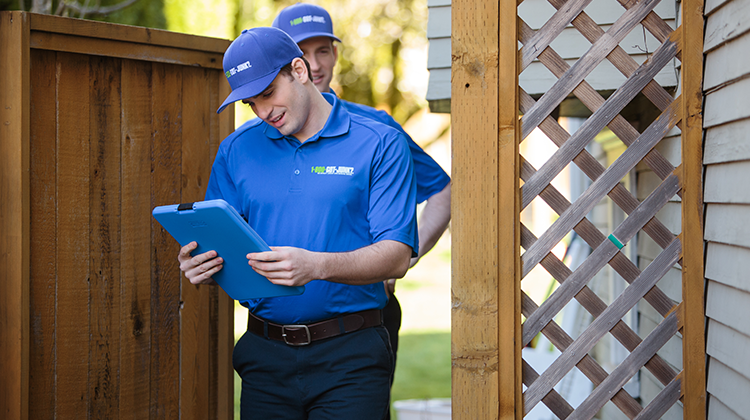
Let 1-800-GOT-JUNK? help finish off your fence project
Tearing down an old fence can be a physically demanding task, but with the right tools and safety precautions, it can be done efficiently and safely. Moreover, by responsibly disposing of the materials through recycling, reuse, or donation, you can minimize the environmental impact of your project.
1-800-GOT-JUNK? can help with the cleanup of your big project. We offer an alternative to troublesome dumpsters. We’ll recycle what debris we can and dispose of the rest responsibly.
If it’s time to get rid of that fence and tidy up your yard, give 1-800-GOT-JUNK? a call!
Frequently asked questions
We price based on how much space your items take up in the back of our truck, broken down into ⅛, ¼, ½, ¾ of a truckload, all the way up to a full truckload. Our trucks hold the equivalent of seven pickup trucks.
Our prices vary based on location and there is a minimum charge for our teams to remove your items, which is different in each location, based on a number of factors, including local disposal and recycling fees.
We offer single item pricing for certain items such as mattresses or TVs, sometimes this will be less than our minimum charge.
For materials that have a heavy cubic weight like dirt, concrete, and gravel, pricing is based on the total volume that the material takes up in the truck, up to a maximum of one foot in height for a full truck.
Watch us load up a truck to see how our standard pricing works!
If you need service weekly, monthly, or quarterly, we offer bulk pricing discounts. This gives you better value compared to common alternatives, such as dumpsters or less professional junk removal services.
Interested? Call our business account team at 1-888-475-3461 to discuss your needs as well as pricing options.
On the day of your appointment with us, our friendly, uniformed truck team members will give you a call or text 15-30 mins before we arrive to let you know we’re on our way.
Whether your business has a single location or multiple locations, we can create a custom junk removal solution that works for you. We can coordinate pickups at multiple locations at a local, regional, and national level. Rather than work with dozens of regional or local companies, let 1-800-GOT-JUNK? handle the jobs across all your locations.
Absolutely! We take large items all the time. As long as it can be lifted and loaded into the truck by two people, we'll be happy to take it away for you!
We work with all types of businesses and can handle any type of job - cleanouts, bulk item removal, general junk removal and even specific items like cardboard or pallets. We can take pretty much anything as long as it's not toxic or hazardous. We can remove your items from wherever they’re located, whether it’s your office, store, site or anywhere else—all you have to do is point!
Yes, we're fully licensed, bonded and insured! We have insurance covering damages to both persons and property for every single booking.
While we don't quite service the entire map, we cover almost every greater metropolitan area across the US, Canada, and Australia. To see if we’re in your neighborhood, you can start a booking by entering your zip code here.
Our customer service center is open 24/7, so we’re here whenever you need us! While operating hours may vary in our franchise locations, we offer same-day and off-hours service, including weekends.
Similar articles
Top 5 reasons storage units aren’t worth it
Think storage units are a lifesaver? They might actually be an expensive trap. While they seem like a quick fix for clutter, these temporary spaces often turn into long-term financial sinkholes for items you’ll never use again. From hidden monthly costs to the lingering mental load, discover five eye-opening reasons why renting a storage unit isn’t worth it.